

Travel Problems in Korea: What to Do and Who to Contact
Travel problems in Korea can feel more complicated when you do not speak Korean or have a local phone number. A bag left on the subway, an uncertain card payment or a locked accommodation entrance can interrupt an otherwise well-planned trip.
The most useful first step is to identify exactly what happened, save the relevant details and contact the person or service that can act on the problem. This guide explains what to check, who to contact and which information to prepare.
1. Know Whether You Need Emergency Help or Travel Assistance
If you need urgent police assistance, call 112. For a fire, rescue or medical emergency, call 119. Give your location as clearly as possible: a street address, building name, station exit or nearby landmark.
For non-emergency tourism questions, travel-related interpretation and tourist complaints, the Korea Tourism Organization provides the 1330 Korea Travel Helpline. In Korea, dial 1330; from overseas, the listed number is +82-2-1330.
Using a data-only eSIM? The official 1330 page offers browser-based chat without an app download, along with an online voice-call option. You will need an internet connection, and availability may depend on the service and language. Save this page before your trip rather than relying only on a telephone number you may not be able to dial.
1330 is not an emergency dispatch service, and it cannot replace your bank, accommodation provider or booking platform when those organizations need to resolve an account or reservation issue.
2. If You Leave Something in a Taxi, Find the Ride Record First
Before trying to retrace the taxi’s route, gather information that could identify the vehicle.
- Booked through an app: Open the completed ride and look for the available driver details or customer-support options.
- Have a receipt: Check for the vehicle number and taxi operator’s contact information.
- Paid by card: Save the payment date, approximate time, amount and merchant information shown in your card account.
- Paid cash without a receipt: Write down the pickup and drop-off locations, approximate times and any vehicle details you remember.
The T-money taxi portal includes lost-item vehicle lookup services for applicable rides. Do not assume every taxi payment uses the same payment provider; follow the service identified in your ride or payment records.
A card notification is not necessarily a full taxi receipt. It may show a charge without providing a vehicle number or driver’s contact details. If the information is incomplete, ask the relevant ride service or payment provider what lookup options are available.
Prepare a precise description: “A small black zippered bag with a red keyring, left on the rear seat” is more useful than “my bag.” Keep distinctive contents or other ownership details available for verification.
Useful message: “I think I left a black bag in the taxi. My ride ended at approximately 9:20 p.m. at [location]. The fare was [amount]. Could you help me contact the driver?”
Local Mate Tip: Keep taxi receipts until you have checked that your phone, wallet and bags are with you. Never post your full card number, security code or banking login details in a public group.
3. If You Lose Something on the Subway, Tell Station Staff Immediately
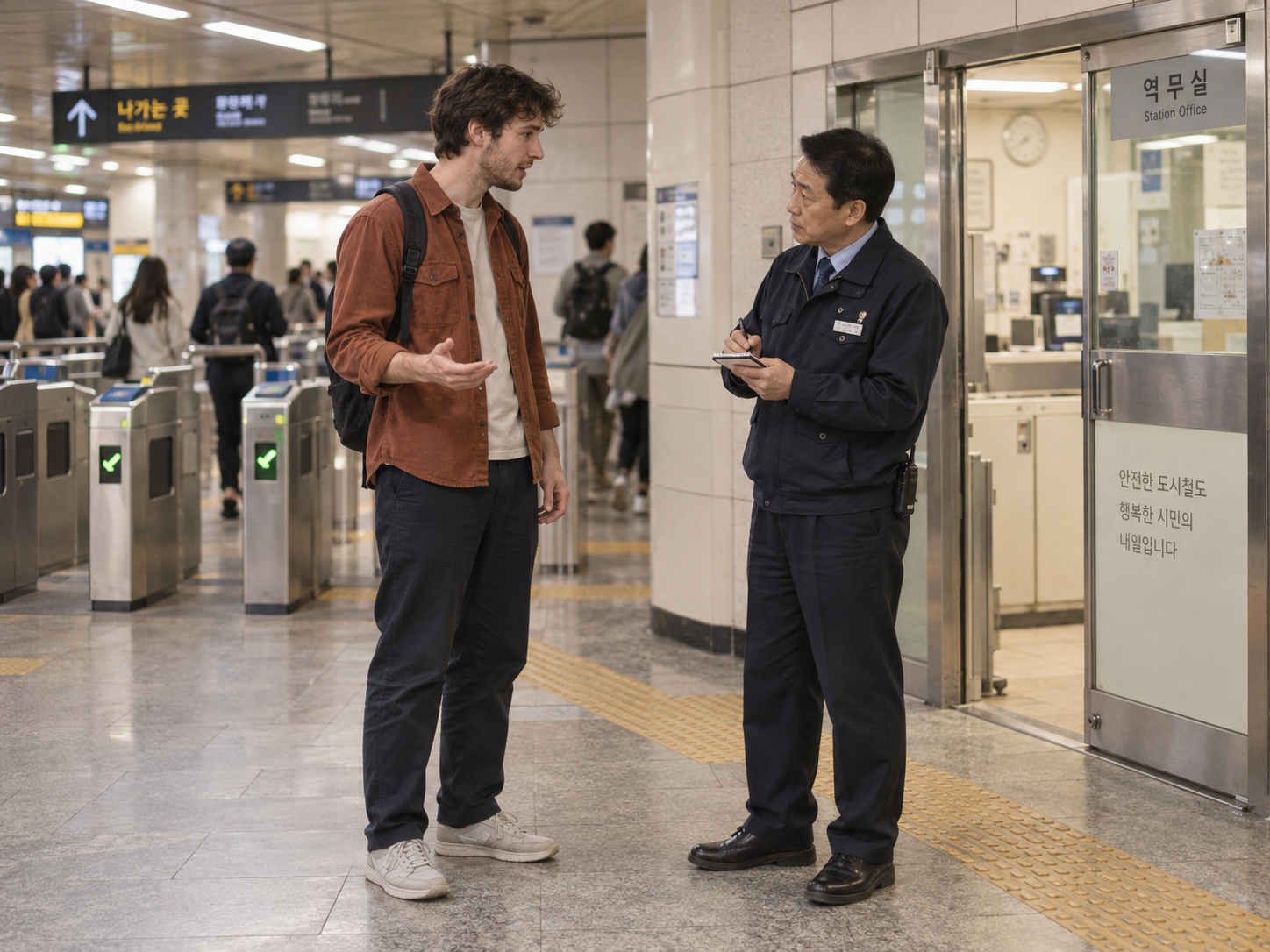
If you notice the loss immediately after stepping off a train, speak to staff at that station before boarding another train to search for it yourself. Accurate timing and carriage information can help staff identify the relevant train, as explained in Seoul’s station-staff guidance.
Prepare these details:
- The subway line and station where you got off.
- The direction of travel, or the next station on your route.
- The approximate time you left the train.
- Your carriage position: front, middle or rear, or a boarding-position number if you remember it.
- The item’s color, size, brand and distinguishing features.
If you are unsure about a detail, say so. A clearly stated estimate is better than confidently giving staff the wrong direction or time.
If you discover the loss later, contact the station or the relevant railway operator. You can also check the police’s Police Civil Service 24 portal, which provides lost-item reporting and found-item searches. The Korean menu labels are 분실물 신고 for reporting a lost item and 습득물 검색 for searching found items. Online reporting may require identity verification; ask about alternatives if you cannot complete it.
Useful Korean sentence to show staff: “열차에 가방을 두고 내렸어요. 약 [시간]에 이 역에서 내렸고, [역 이름] 방향으로 가는 열차였어요.”
This means: “I left my bag on the train. I got off at this station at about [time], and the train was traveling toward [station name].” Replace the bracketed details before showing it.
Local Mate Tip: Before traveling to collect an item, confirm where it is being held, the collection hours and what proof of ownership or identification you need. Do not assume it is still at the station where you lost it.
4. Avoid Accommodation Problems Before a Late Arrival
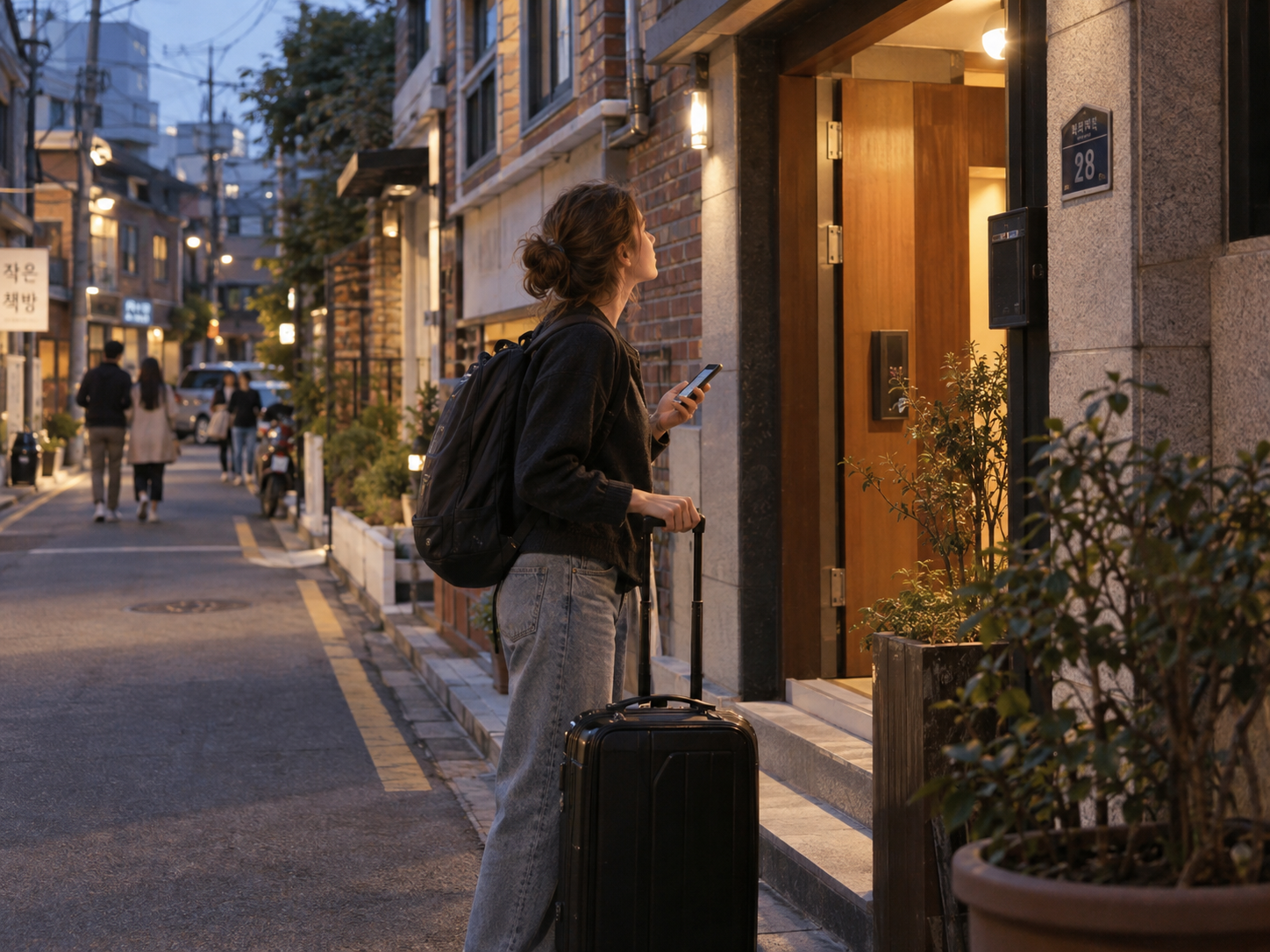
Search the Exact Address, Not Only the Property Name
Accommodation names can be similar, and one brand may operate several branches. Searching only the name can take you to the wrong property.
In our accommodation operations, we have had guests book a Sinchon branch but arrive at a Hongdae branch instead. A familiar-looking name in a map search does not confirm that you have found the place you reserved.
- Check the exact branch name and full street address in your booking confirmation.
- Enter that address into your map app and save the location.
- Ask for the Korean address, floor information and an entrance photo if the building is difficult to identify.
- If the booking details and map listing disagree, contact the host through your booking platform before traveling there.
Tell the Host When You Expect to Arrive
If you expect to arrive late at night, send your estimated arrival time through the booking platform in advance. Confirm that late check-in is permitted and ask whether it requires any special arrangements.
Request instructions for the entire route into the property: the building entrance, any floor entrance and your room. Different doors may use different codes. Ask how to activate the keypad and whether the code needs a final symbol such as * or #.
Your host may not be available to answer immediately at night. Read the instructions before departure, resolve unclear points and save the guide offline. Also confirm the contact method to use if your arrival is delayed or you cannot enter.
Message to send before arrival: “Hello, I expect to arrive at the property at approximately 11:30 p.m. Could you confirm that late check-in is possible and send the entrance and door-lock instructions? Please also confirm the exact branch address and the contact method for access problems.”
If the Door Still Does Not Open
First verify the address, floor and room number. Then check that you are using the instructions for the door in front of you, not a different entrance.
Tell the host which door is affected, whether the keypad lights up and what sound or message appears after entry. Send an entrance photo privately if needed. Avoid repeated random attempts, forcing the door or dismantling the lock.
If the host cannot be reached, use the booking platform’s available support channel. Stay somewhere safe while seeking help. Do not assume a platform can arrange immediate entry or reimburse alternative accommodation; ask what assistance and conditions apply.
Local Mate Tip: Never share door codes, room numbers or screenshots containing access instructions in a public community. Send them only through the appropriate private support channel.
5. If a Card Payment Fails, Check Before Trying Again
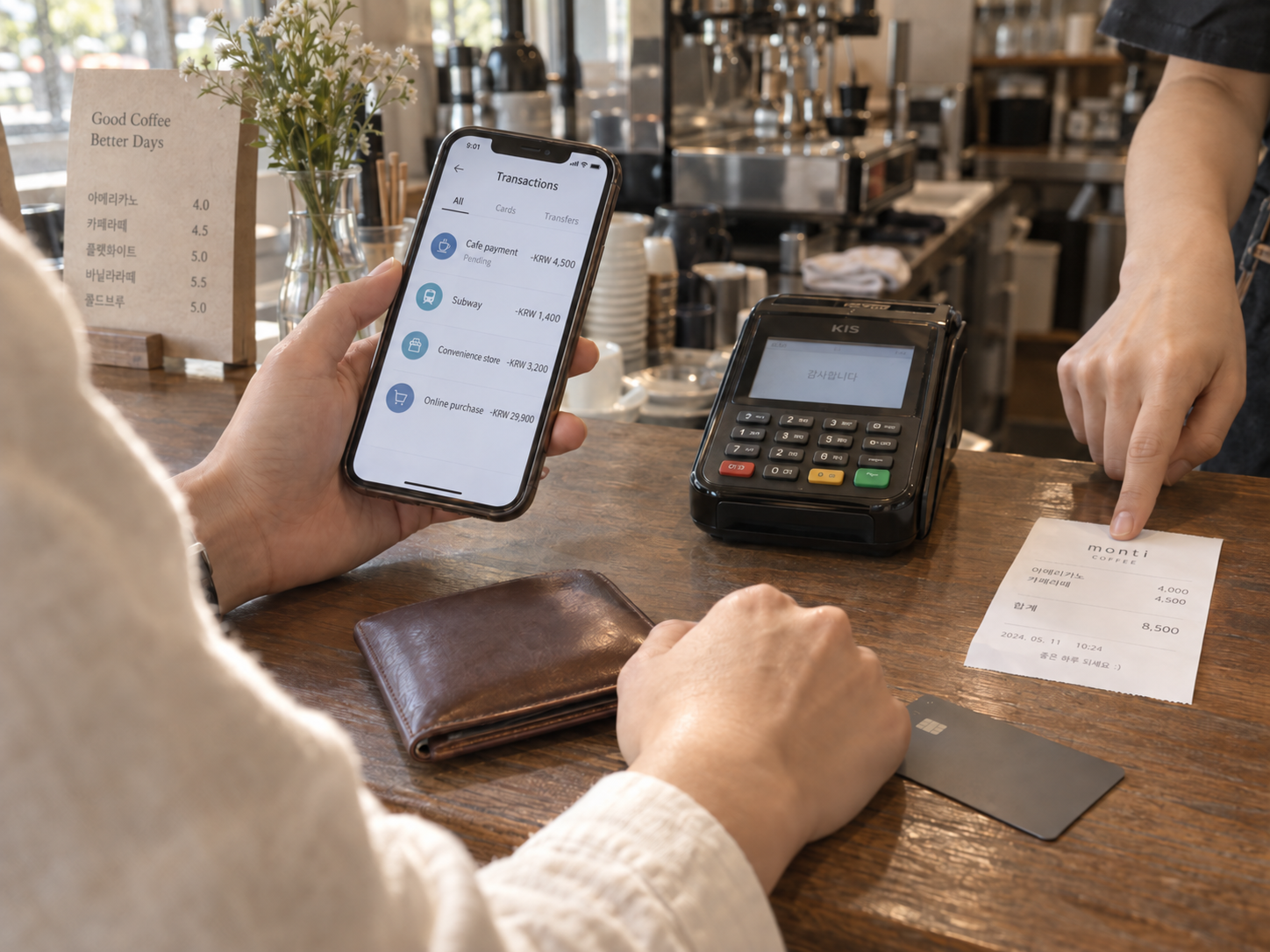
A failed payment screen and a card notification can leave you unsure whether the transaction went through. Do not immediately repeat the payment several times.
- Check the merchant’s result. In a shop, ask staff whether payment was approved. Online, check the order or reservation page and confirmation messages.
- Check your card account. Record whether the transaction is pending, completed, declined or reversed, using the wording your issuer provides.
- If the results disagree, contact the merchant. Ask whether an order exists and whether another payment is necessary.
- Contact your card issuer if needed. Provide the merchant, amount, time and exact error message through the issuer’s official support channel.
A pending entry alone does not establish that an order is complete or that you have been charged twice. Your merchant and card issuer need to clarify the transaction. Processing and reversal times vary, so avoid relying on a fixed refund timeline.
Useful Korean question: “결제가 승인됐나요? 다시 결제하기 전에 확인해 주세요.”
This means: “Was the payment approved? Please check before I pay again.”
Local Mate Tip: Keep the receipt and relevant screenshots until the issue is resolved. Do not give a stranger your card security code, one-time verification code or banking password to “fix” a payment.
6. When a Korean Notice Is Unclear, Confirm the Important Details
Image translation is useful for understanding a sign or message, but check the details that could change what you pay or where you go.
- Dates and times: Is the notice about today, a future date or a deadline?
- Prices: Is the amount per person, per night or the total?
- Fees: Is it a refundable deposit or a charge?
- Cancellation terms: What is the deadline, and which conditions apply?
- Locations: Does it refer to an entrance, exit, floor or boarding point?
Keep the original photo, not only the translated version. Crop and translate one section at a time if the full image produces confusing results. For an important condition, show staff the original and ask a specific question rather than requesting a general explanation.
Useful Korean question: “이 금액이 총액인가요, 아니면 1인당 금액인가요?”
This means: “Is this the total amount, or the amount per person?”
7. Save a Small Help Kit Before You Travel
Keep the following information somewhere you can access without searching through multiple emails:
- Your accommodation’s exact Korean address, branch name and entrance photo.
- Offline check-in instructions and the agreed contact method.
- Booking references and the relevant platform’s support details.
- Your card issuer’s official support information.
- The official 1330 web page for non-emergency travel assistance.
- A way to access essential information if your phone is lost, such as a paper address card or a secure copy accessible from another device.
Store access codes and identity documents securely rather than in a public shared folder. For more arrival preparation, read our first-time travel guide to Korea.
Have a Non-Urgent Korea Travel Question?
The Korea Local Mate Facebook group is a space to ask travel-planning questions and share experiences about visiting Korea. When posting, include the relevant area, date and what you have already checked—but remove private booking, payment and access information.
Community replies are not guaranteed or a substitute for emergency services, official requirements, your host or your bank. Use the group for non-urgent questions and experience sharing, and verify important details with the responsible provider.
Final Thoughts
When something goes wrong, precise information is more useful than repeated attempts or a vague request for help. Save the time, location and relevant records, then contact the service that can take action.
A few checks before departure—especially your accommodation’s exact branch address and late check-in instructions—can prevent a stressful situation altogether.
Travel prepared, ask clearly and enjoy Korea. — KR